
Half-Drop vs Straight Repeat: Place the Same Motif
Compare straight, half-drop and half-brick layouts using one original motif. Check the translations, rectangular repeat cells and matching edge fragments.
On this page
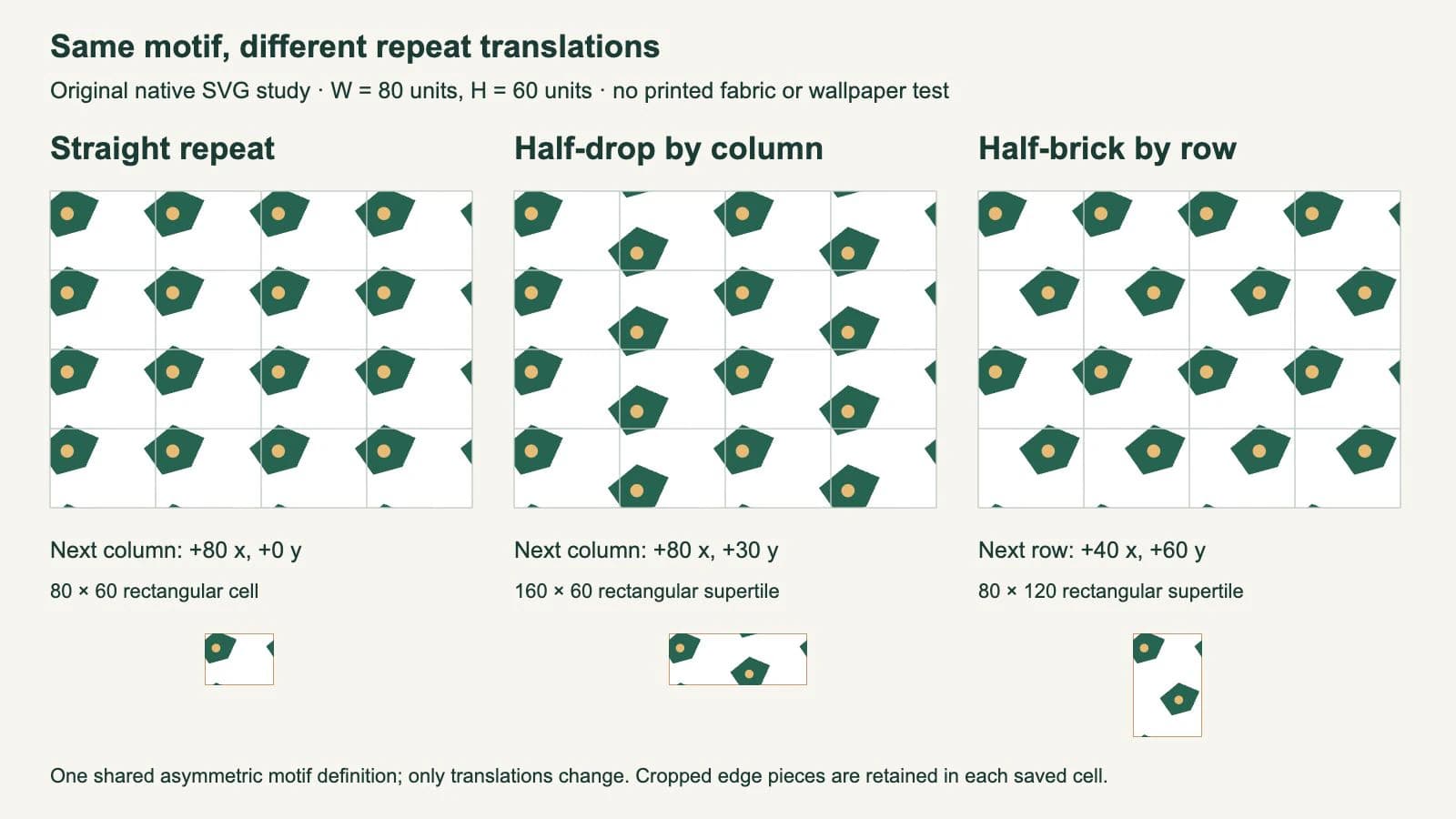
A straight repeat places the same artwork in aligned rows and columns. A half-drop repeat shifts each neighboring column vertically by half the repeat height. The motif can stay unchanged: its placement changes. A half-brick repeat shifts neighboring rows horizontally instead, so name the direction as well as the fraction.
That choice affects both the visible arrangement and the file you hand off. A rectangular tile that repeats straight may need to contain two staggered columns to reproduce a half-drop layout. Changing a repeat menu does not automatically repair missing artwork at an edge.
Separate the motif from the repeat positions
A motif is an individual piece of artwork used in a pattern. A repeat cell contains enough artwork to reconstruct the larger pattern by the intended translations. Its dimensions are not necessarily the dimensions of one visible flower, leaf or badge.
Spoonflower’s repeat definitions distinguish a basic straight arrangement, a vertical half-drop and a horizontal half-brick. Pattern Observer’s comparison also explains that a straight, or full-drop, repeat can use a rectangular cell; it need not be square.
Here, column half-drop means that moving one column to the right also moves the artwork down by half its vertical spacing. We use SVG coordinates, where positive y points down. Specifying those directions avoids confusing this arrangement with a half-brick or with a drawing rotated on the page.
| Arrangement | Move to the next column | Move to the next row |
|---|---|---|
| Straight | Full width right, no vertical shift | Full height down |
| Column half-drop | Full width right, half height down | Full height down |
| Row half-brick | Full width right | Half width right, full height down |
None of these definitions requires mirroring or rotating the motif. Those are additional artwork decisions, with their own effect on directional details.
Follow one original asymmetric motif
We authored a five-sided green motif with a separate gold circular accent. Its uneven outline and off-center accent make a flip or rotation easier to spot than a symmetric dot would. All three arrangements reference the same native SVG definition.
Our chosen spacing is W = 80 and H = 60 drawing units. These are layout inputs, not millimeters or a textile supplier’s preferred repeat size. The first motif’s anchor is at (5, 15); its local bounds extend from (-14, -18) to (32, 20). Some copies therefore cross the chosen cell edges deliberately.
For the straight arrangement, move 80 units right or 60 units down to reach an equivalent motif. For the half-drop, move (80, 30) to reach the next column, or (0, 60) to move within one column. These two moves are the arrangement’s lattice vectors: the translations that generate its repeated positions.
An anchor list makes the difference concrete:
| Column | Straight anchors at the start of a vertical period | Half-drop anchors at the start of a vertical period |
|---|---|---|
| First | (5, 15) | (5, 15) |
| Second | (85, 15) | (85, 45) |
| Third | (165, 15) | (165, 75), equivalent vertically to (165, 15) |
The third half-drop column returns to the first column’s vertical phase after one full 60-unit period. The shape itself has not stretched. Our SVG pattern-units guide treats the separate choice of tile coordinates and motif scaling.
Export two staggered columns as a straight rectangular tile
For this example, an ordinary straight repeat needs an 80 × 60 rectangular cell. The half-drop arrangement can be stored in a 160 × 60 rectangular supertile containing two column phases. A supertile is a larger repeat cell assembled from the smaller repeated arrangement.
Why double the width? Two half-drop column moves total (160, 60). Moving back one complete vertical period leaves (160, 0), so 160 units right is also a valid translation of this pattern. The vertical period remains 60.
The half-brick control uses the opposite construction: an 80 × 120 rectangular supertile holds two row phases. This is why “offset every other repeat” is incomplete advice. You need to know which direction is staggered and which rectangular cell the receiving system will repeat.
Keep fragments that cross the cell boundaries. If a motif extends past the left side, its corresponding continuation belongs at the right side. Apply the same rule at top and bottom. Do not squeeze the protruding shape inward or delete a small-looking fragment just to make the tile look tidy in isolation.
Our patternTransform explanation covers moving or transforming an existing pattern coordinate system. That operation is separate from assembling the correct edge content for a new repeat cell.
Check the saved cells, not only the arrangement preview
We reopened the three actual SVG cell exports. Each retained the same five-point polygon and circular accent, and every instance used only a translation. There was no rotation, reflection or per-copy shape scaling.
We then checked the copies that crossed each cell boundary and verified that their opposite-edge continuations were present at the expected cell-width or cell-height translation. Finally, we compared the tiled cells with an independently enumerated larger lattice at 115,200 sample positions per arrangement. All 345,600 sampled paint comparisons matched.
That is a digital check of these original cells. It is not an exhaustive test of every possible shape, a raster-export seam test or proof of printed fabric. The retained source references and exact translations establish motif identity; the sample comparison checks that the saved rectangular cells reproduce the intended field at the tested positions.
For your own design, preview several repeats across both directions. Look for cut motifs, unexpected empty bands, duplicate edge fragments and obvious clusters. Inspect the actual delivery export too: a small resampling or canvas-size change can produce a different file from the native master.
A one-dimensional strip has its own constraints. The washi-tape repeat guide examines that seam without assuming it proves a two-dimensional layout.
Choose the arrangement by the artwork, then proof the output
Straight repeats make aligned columns easy to see. A half-drop changes that alignment, but it does not guarantee an invisible repeat or a better composition. An uneven cluster can still recur diagonally, and a large directional motif can remain conspicuous.
Judge the actual spacing, empty areas and direction of movement. Keep an approved native version of each arrangement so that a later color or size change does not accidentally mix two constructions. Record whether the supplied file is already a two-column straight-repeating supertile or is intended for an additional half-drop setting. Applying the offset twice changes the arrangement again.
The receiver’s requirements still matter. Spoonflower’s proofing guidance separates digital repeat checks from sampling the physical product for final color and quality. We did not upload these files there or test a fabric, wallpaper or installation process.
If a suitable flat motif exists only as a PNG or JPG and needs editable contours, PerfectVector’s image-to-vector workflow can prepare an SVG candidate. Compare its outline, accent and small openings against the source before placing repeated copies. Vectorization does not choose a repeat lattice, invent missing edge fragments or certify the finished production file. Our example motif was authored directly as vector artwork.
FAQ
What changes between a straight repeat and a half-drop repeat? The motif positions change. In the column half-drop used here, the neighboring column shifts down by half the vertical repeat height; the original motif can remain unchanged.
Is a half-drop the same as a half-brick repeat? No. The column half-drop shifts neighboring columns vertically. A row half-brick shifts neighboring rows horizontally. State the direction rather than relying only on the word staggered.
Can a half-drop pattern use a rectangular tile? Yes. Our example uses a straight-repeating 160 × 60 supertile with two staggered column phases. Keep the matching edge fragments and confirm whether the receiver expects that completed tile or a separate repeat setting.
Sources
- Spoonflower: Repeat Options — Basic, half-drop and half-brick arrangement definitions.
- Pattern Observer: Half Drop Repeats vs Full Drop Repeats — Straight rectangular repeats and vertically staggered neighboring columns.
- Spoonflower: Proofing Your Design — Separate digital checks and physical product sampling.
Need editable shapes from a raster-only motif? Create and inspect an SVG candidate, preserve the accepted artwork, then build and check the intended repeat cells separately.
More from the blog

Punchboard Bleed: Check the Neighboring Token Gap
Check how neighboring punchboard bleeds compete for space. Inspect original SVG and PDF geometry, preserve the die contours, and confirm your supplier's rules.

Tapered Tumbler Wraps: Compare the Edge Lengths
See why a tapered wrap uses unequal curved edges. Follow an original frustum calculation, check both arc lengths and separate ideal geometry from a real blank.