
Tapered Tumbler Wraps: Compare the Edge Lengths
See why a tapered wrap uses unequal curved edges. Follow an original frustum calculation, check both arc lengths and separate ideal geometry from a real blank.
On this page
- Identify the surface before choosing a template
- Keep vertical height and slant height separate
- Derive the curved strip from those lengths
- Check the saved sector rather than trusting the labels
- Keep the seam and production allowances separate
- Choose the artwork format after the shape is understood
- FAQ
- Sources
A tapered tumbler has different circumferences at the top and bottom of its printable band. A rectangle has equal-length opposite edges. For an ideal conical side, the flattened wrap is an annular sector: a curved strip whose two arcs have different lengths. Changing a rectangle’s width cannot make both edges match two unequal circumferences without some other deformation, gap or overlap.
Start with the actual blank and its supplier’s template. The calculation below explains one ideal shape; it is not a ready-to-press template for a named tumbler, a substitute for measuring its printable region or proof of physical fit.
Identify the surface before choosing a template
A conical frustum is a cone with its tip removed by a cut parallel to its base. We consider a right circular frustum with circular, parallel top and bottom boundaries and a straight sloping side. MathWorld’s frustum definition and formulas describe that ideal geometry.
An annular sector is a slice of a ring bounded by two concentric circular arcs and two radial sides. When the ideal frustum’s side is opened along one sloping line, those radial sides become the two seam edges. The outer arc corresponds to the larger circumference, and the inner arc to the smaller one.
| Surface or region | What determines the flat boundary | What still needs checking |
|---|---|---|
| Ideal straight cylinder | Equal top and bottom circumferences | Actual printable band and required allowances |
| Ideal conical frustum | Unequal circumferences and a straight slope | The corresponding curved-sector geometry |
| Real cup with a shoulder, bevel or changing slope | The actual local shape | Supplier template, measurement and physical fit |
| Handle or excluded coating area | Product construction | Which regions must remain clear |
A tumbler can contain more than one kind of region. A straight middle band does not make a tapered base cylindrical, and a conical calculation does not automatically describe a rounded shoulder.
Keep vertical height and slant height separate
Our original example has a chosen top radius R = 45 mm, bottom radius r = 30 mm and vertical height h = 84 mm. These are educational inputs, not measurements of a commercial blank. The corresponding diameters are 90 and 60 mm.
The distance along the sloping surface is the slant height, s. It is longer than the vertical height because the side also changes radius:
s = sqrt(h² + (R − r)²)
  = sqrt(84² + 15²)
  ≈ 85.329 mm
Use full precision while constructing the geometry; the displayed values here are rounded to three decimals. Substituting the vertical 84 mm for the slanted distance changes the flattened strip’s radial thickness.
The two circumference lengths are independent checks:
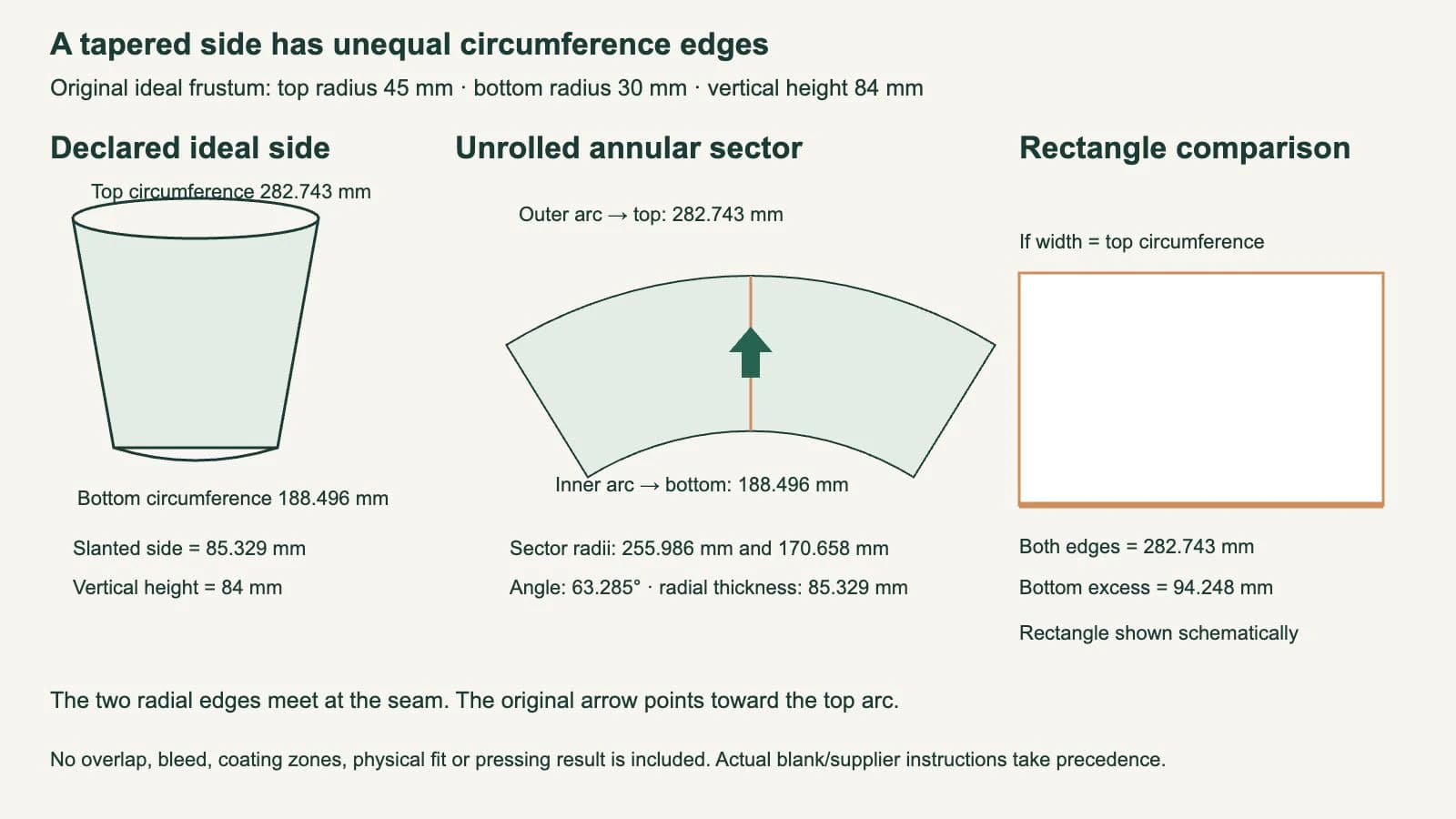
Top:    2πR = 2π × 45 ≈ 282.743 mm
Bottom: 2πr = 2π × 30 ≈ 188.496 mm
Their difference is about 94.248 mm. A rectangle whose width matches the top would have that much excess edge length relative to the bottom in this ideal, allowance-free comparison. This is an edge-length calculation, not a prediction of where real transfer paper will wrinkle.
Derive the curved strip from those lengths
Let L be the flattened sector’s outer radius and l its inner radius. These are distances from the center of the flat construction; they are not the cup’s 45 and 30 mm radii.
The radial thickness must equal the slant height, so L − l = s. The ratio of the two arc lengths must also match the cup’s circumference ratio. With a shared sector angle, that gives:
L = R × s / (R − r) ≈ 255.986 mm
l = r × s / (R − r) ≈ 170.658 mm
θ = 2π(R − r) / s  ≈ 1.104525 radians
                       63.285 degrees
The arc-length rule is radius multiplied by angle in radians. Checking the flattened construction gives Lθ = 2πR and lθ = 2πr. Both edge lengths agree with the ideal frustum, while L − l agrees with its slanted side.
Templatemaker’s truncated-cone tool illustrates the practical use of concentric arcs and separate top, bottom and height inputs. Our sector was authored independently; we did not download or test that tool’s output or add its glue-flap options.
Check the saved sector rather than trusting the labels
We saved an original native SVG sector, reopened it and read its actual arc radii and endpoints. The verification derived the included angle from those endpoints, then compared the two arc lengths with the independently calculated circumferences. The saved radial thickness also matched the slant height.
A second check sampled 1,111 surface-coordinate positions across the ideal strip. Mapping the angular coordinates back around the cone preserved the corresponding circumferential distances. At each tested height, the two seam endpoints returned to the same surface position within numerical tolerance.
Those checks establish consistency of this mathematical example. They do not prove physical fit, printer scaling, coating coverage, transfer behavior or a manufacturing tolerance. We did not cut paper, wrap a cup, operate a press or test a supplier template.
The figure’s arrow is original native artwork pointing toward the outer, top arc. It shows orientation only. We did not test a full-image conical warp or establish that all lettering stays visually straight after an arbitrary design transformation. Keep the intended top, bottom and seam roles explicit when placing real artwork.
Keep the seam and production allowances separate
The two radial edges represent the same join on the ideal surface. An overlap allowance adds material beyond a chosen join; it does not change the underlying circumference the geometry is intended to cover. Bleed and protected artwork zones also have separate purposes.
Follow the chosen blank and process instructions for those additions. Jennifer Maker’s tapered-tumbler workflow uses the actual cup’s top circumference, bottom circumference and height to prepare its template. Its example dimensions and application steps belong to that project, not to every cup carrying the same capacity label.
Keep an editable design master and a separate delivery copy. Check which boundary the template represents, which side is the top, where important details approach the seam and whether the actual printable band includes a transition in slope. Test the unheated paper fit and final process through the receiver’s recommended workflow; our calculation does not replace those checks.
A real blank may also require a differently shaped or interrupted template. Stop applying the ideal sector when its assumptions no longer describe the surface. Adjusting a photograph by eye until its outer box fits a guide is not an independent check of the cup’s geometry.
Choose the artwork format after the shape is understood
A curved outline and an SVG extension answer different questions. The outline describes the region. The file format describes how its content is stored. Our SVG or PNG for sublimation guide separates the editable design master from the raster delivery used in a print workflow.
Keep photographs and textured imagery as suitable raster artwork. Tracing does not make their missing detail reappear or solve the curved placement. The AI-art print guide explains when flat shapes benefit from vector reconstruction and when the original pixels are the better source.
If a flat logo or motif exists only as a bitmap and needs contour editing, PerfectVector’s image-to-vector workflow can prepare an SVG candidate. Compare its silhouette, lettering and openings against the source, then place the accepted artwork in the actual template. Vectorization does not measure a tumbler, calculate its sector or guarantee a rectangle fits a taper. Use the SVG editing guide for the separate path and paint work.
FAQ
Why are tapered tumbler templates curved? An ideal conical side has unequal top and bottom circumferences. Its unrolled annular sector uses different-length arcs connected by radial seam edges; a rectangle has equal-length opposite edges.
Can I resize a straight rectangle to fit both edges? Changing its width leaves its top and bottom edges equal. It cannot match two unequal circumference lengths without another deformation, gap or overlap. Use the actual blank’s template and fit checks.
Is the printable height the same as the slant height? Not necessarily. For the ideal frustum here, vertical height is 84 mm and slant height is about 85.329 mm. Confirm how the selected template defines its height and which region of the real cup it covers.
Sources
- Wolfram MathWorld: Conical Frustum — Ideal right-circular-frustum geometry and slant-height relationship.
- Templatemaker: Cone, truncated — Concentric-arc construction and distinct top, bottom, height and flap inputs.
- Jennifer Maker: How to Sublimate Tapered Tumblers — A project-specific workflow using the actual cup’s top and bottom circumferences and height.
Need editable contours from a raster-only motif? Create and inspect an SVG candidate, keep the accepted artwork, then confirm the actual wrap template and physical fit separately.
More from the blog

Convert Watercolor Art to Vector and Keep Its Feel
Learn when watercolor art should stay raster, when vectorizing helps, and how a real SVG trace changes soft washes into editable color shapes you can reuse.

Convert PNG Icons to SVG for a Consistent UI Kit
Turn a folder of PNG icons into a coherent SVG set. Learn how to standardize artboards, optical size, colors, paths, and delivery checks across a UI kit.